LP 32/2026 The Baltimore Bridge Collision: A Stress Test for P&I Club Mutual Mechanism
In March 2024, the M/V Dali allided with Baltimore’s Francis Scott Key Bridge, triggering the largest P&I claim in International Group history — an estimated USD 2.8 billion loss that tests the upper limits of the Group’s reinsurance programme. This article examines how the P&I club mutual mechanism performs under extreme catastrophe stress, from underwriting practice to reinsurance architecture.
I. The Largest Claim in P&I History
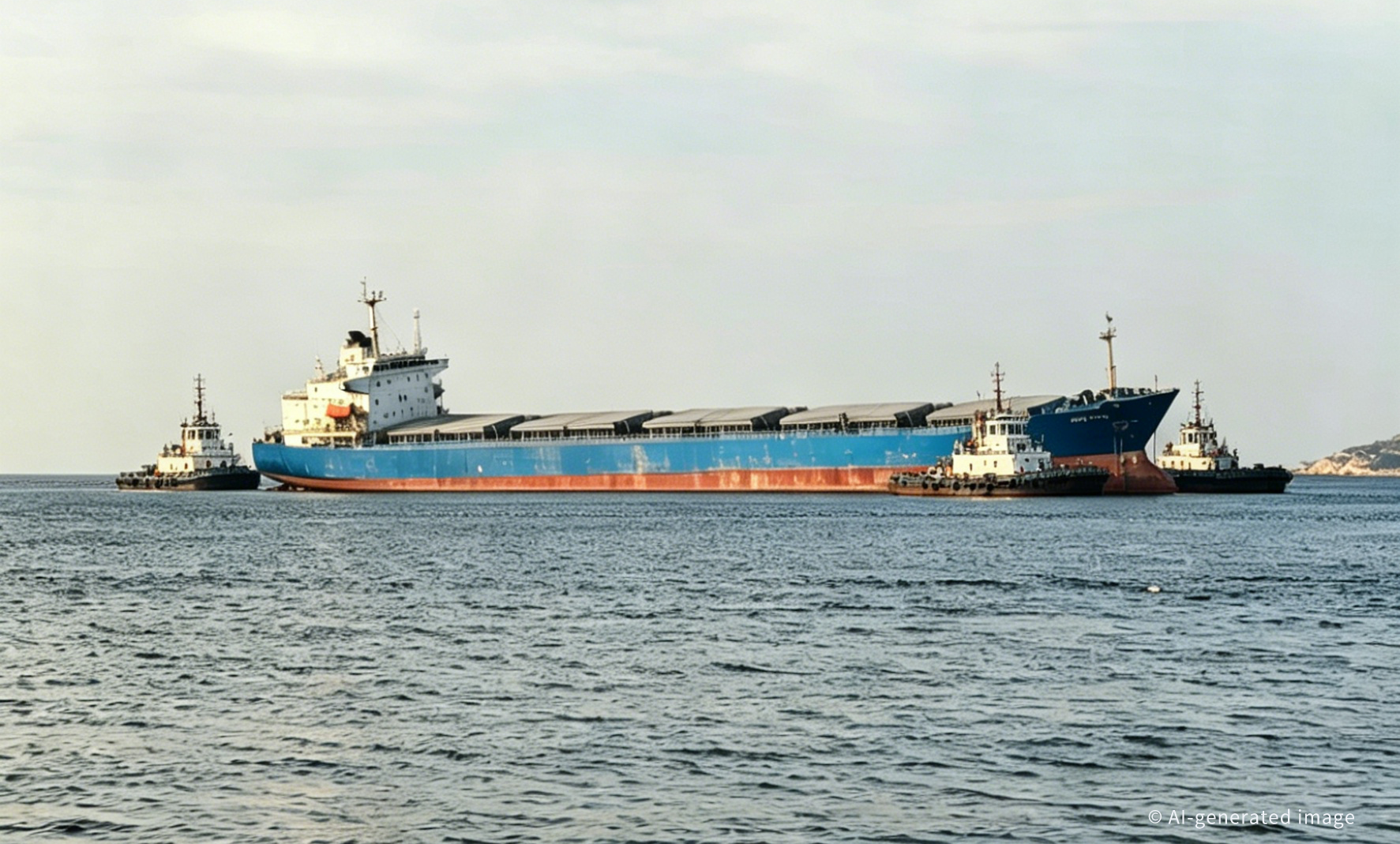
On 26 March 2024, the Singapore-flagged container vessel Dali (95,128 GT) suffered a complete blackout shortly after leaving Baltimore, lost propulsion and steering, and allided with the Francis Scott Key Bridge. The main span collapsed in 13 seconds. Six workers were killed, and one of the US East Coast’s busiest shipping channels was closed for over two months.
The NTSB’s final report (Marine Investigation Report MIR-25-40) traced the cause to improperly placed wire-label banding on terminal connection wires, which prevented secure contact inside a high-voltage switchgear panel and caused a total loss of electrical power.
Howden Re puts the total insured loss at roughly USD 2.8 billion — well above the Costa Concordia’s USD 1.6 billion and the largest P&I claim in IG Group history. Yet the vessel owner’s limitation fund under the US Limitation of Liability Act of 1851 is only about USD 44 million. That gap — between a USD 44 million fund and a USD 2.8 billion exposure — is exactly why the P&I mutual system exists, and the subject of this article.
II. Loss Profile and Insurance Arrangements
1. Liability Landscape
Claims against the owner and manager fall into five buckets:
· Federal government claims under the Rivers and Harbors Act, the Oil Pollution Act and other statutes, for waterway clearance, wreck removal and emergency response costs — approximately USD 103 million;
· State of Maryland claims for bridge replacement, toll revenue loss and environmental damage (replacement cost estimated at USD 4.3–5.2 billion);
· Death and personal injury claims brought by the families of the deceased workers and surviving workers;
· Pure economic loss claims, such as business interruption, by businesses and insurers affected by the bridge closure;
· Cargo damage and general average contribution in respect of 4,680 laden containers.
Six days after the incident, the shipowner filed a petition for exoneration from or limitation of liability in the US District Court for Maryland, consolidating all claims into a single proceeding. By 24 September 2024, 46 claims had been filed. The case has since run on three tracks:
Civil: on 25 August 2026, the court dismissed most pure economic loss claims under the Robins Dry Dock rule, which bars recovery for pure economic loss in maritime tort absent physical damage to the claimant’s own property;
Settlements: federal government claim — approximately USD 102 million (October 2024); State of Maryland — USD 2.25 billion (May 2026); family claims — settled the same month;
Criminal: on 13 May 2026, the US Department of Justice charged two Synergy entities and MV Dali’s technical superintendent with conspiracy, misrepresentation and obstruction.
Both Maryland and the shipowner have also sued Hyundai Heavy Industries, alleging switchboard design and manufacturing defects.
2. Insurance Arrangements
· P&I cover: the vessel is entered with Britannia P&I Club, covering loss of or damage to property, third-party death and personal injury, cargo liability, wreck removal liability and related costs under the club’s rules;
· Hull and machinery: insured value of USD 90 million, to be borne by the hull underwriters;
· Bridge property insurance: placed with ACE American for USD 500 million, paid in full in May 2024; the subrogated claim will subsequently be joined into the claims against the vessel interests.
Beyond direct indemnity, the P&I club faces substantial defence costs from two years of multi-track litigation, plus complex general average expenses.
III. How the IG Pool Absorbs a Catastrophe
1. The IG Group Mutual Pooling Mechanism
For the 2024 policy year, the IG Group’s mutual pooling and collective reinsurance mechanism was structured in five layers:
· Losses below USD 10 million: borne by the individual P&I club (e.g., Britannia) – the individual club retention;
· USD 10 million to USD 30 million: pooled among the 12 Group clubs in proportion to entered tonnage and calls — the Pool layer;
· USD 30 million to USD 100 million: borne by Hydra Insurance Company Limited, the IG Group’s Bermuda-based captive reinsurance company;
· USD 100 million to approximately USD 2.1 billion: covered by the IG Group’s collective Group Excess of Loss (GXL) reinsurance programme;
· USD 2.1 billion to approximately USD 3.1 billion: covered by the IG Group’s Collective Overspill reinsurance (the catastrophe layer); any amount beyond that is again pooled among the 12 clubs and may trigger an Overspill Call.
2. Impact on Britannia P&I Club
Britannia’s own share is just its USD 10 million individual retention plus its pro-rata slice of the Pool layer. Everything else is spread across the other 11 IG clubs and the global reinsurance market. At an estimated USD 2.8 billion, the loss remains within reinsurance limits — no Overspill Call has been triggered.
Financially, Britannia took a hit but stayed solid. In 2024/25, it posted a 137.7% combined ratio and a USD 9.8 million net loss, with free reserves edging down from USD 549.9 million to USD 540.1 million. S&P downgraded it from A to A– (stable). The full picture, though, is broader: total IG pooled losses that year were approximately USD 467 million, so Dali alone doesn’t explain the combined ratio spike.
By 2025/26, Britannia had bounced back: retained-layer claims fell 25% year-on-year, investment returns hit 9.0%, and the club booked a USD 60.9 million profit. The combined ratio improved to 111.3%, free reserves hit a record USD 572.2 million, and entered tonnage grew from 143.7 million GT to 149.2 million GT.
3. Impact on the IG Reinsurance
In the immediate aftermath of the Dali incident, the industry generally assessed that the loss would be contained at around USD 1.5 billion. Accordingly, the IG Group made structural adjustments to its reinsurance programme renewal for the 2026/27 policy year:
1) Increased Catastrophe Layer
Layer 3 of the GXL (excess of USD 1.5 billion) was increased from USD 600 million to USD 850 million, raising the Collective Overspill attachment point from USD 2.1 billion to USD 2.35 billion and the total reinsurance limit (including the Collective Overspill) to USD 3.35 billion.
2) Repricing by Vessel Type
Reinsurance was repriced by vessel type. Fully cellular container ship (FCC) rates rose 15%; everything else stayed flat or fell materially.
3) Increased Private Placement Share
The number of private placements in Layer 1 of the GXL increased from three (25% combined share) to four (27.5% combined share), reducing the open market share to 72.5%. Hydra’s Annual Aggregate Deductible (AAD) in Layer 1 was reduced to USD 103.6 million.
When Maryland’s USD 2.25 billion settlement was announced in May 2026, the total loss estimate jumped to approximately USD 2.8 billion. One GXL reinsurer signalled it might deny coverage over the rapid loss escalation; the IG Group quickly approved advance funding for any resulting shortfall, allowing Britannia to settle with Maryland on time. The episode also foreshadows a more granular approach to IG risk modelling — by vessel type, geography and accident type — which will feed through into pricing at the 2027 renewal.
IV. What the Stress Test Reveals
1. Extreme Loss Absorption Capacity
A USD 2.8 billion risk sat with one club — but the club’s own share was tiny. Reinsurance absorbed nearly everything. None of the 12 IG clubs faced a capital crisis, and several kept returning premiums to members as usual. When one reinsurer threatened to deny coverage, the IG Group stepped in to bridge the gap without disrupting claims — a clear demonstration of the mutual model’s deep loss-absorbing capacity.
2. Making Open-Ended Liability Insurable
The mutual model turns open-ended third-party liability — the kind commercial insurers won’t touch in a single year — into manageable risk, using post-event tools like supplementary calls and overspill calls. Dali may keep 2024 policy-year books open for some time, but that’s by design: the mechanism trades time for space. Making open-ended liability insurable is the core value P&I clubs have delivered since 1855.
3. Integration of Underwriting and Claims Management
Britannia posted USD 43.671 million in security in its own name and submitted to the Maryland court’s jurisdiction; it also settled the federal government claim for USD 102 million. The limitation proceeding consolidated 46 claims into one fund, and the Robins Dry Dock ruling in August 2026 knocked out all pure economic loss claims at a stroke. This integration of underwriting and claims — deep involvement in every stage of a case — is what makes P&I clubs different.
4. Financial Flexibility Without Shareholders
Even in a 137.7% combined-ratio loss year, Britannia returned USD 30 million in calls to renewing members. The year after, back in profit, it distributed another USD 43.8 million. P&I clubs aim for breakeven at a pace the board sets — not underwriting profit. Returning money in a loss year is something no commercial insurer could possibly imagine.
5. Network Effect of Market Access
Through it all, the IG Group’s grip on approximately 90% of ocean-going tonnage hasn’t wavered. The P&I Blue Card and Certificate of Entry remain passports for port access, charter parties and ship financing. That Members stay on after a catastrophe confirms the self-reinforcing power of this network.
V. Conclusion
The Dali case has provided a rare end-to-end stress test of the P&I Club mutual mechanism. The mutual pooling and reinsurance mechanism effectively absorbed the low-frequency, high-severity catastrophe risk that materialised under extreme circumstances, without triggering any club-level capital crisis — validating the extreme resilience of the mutual model. The ability of P&I Clubs to underwrite the industry’s largest open-ended liability risks also effectively fills a gap in the commercial insurance market.
At the same time, the incident raises a series of questions that P&I Clubs will need to consider going forward:
· How will liability classes with no historical benchmark be priced in future?
· The Robins Dry Dock rule has shielded clubs from pure economic loss claims in the order of billions of dollars, making legal rules a de facto form of “reinsurance” for Clubs — yet this rule faces continuing erosion pressure.
· The mutual pooling mechanism has no shareholder capital to absorb losses; all adjustment tools are post-event calls, meaning both Clubs and Members must reserve room for calls in respect of cases from several years prior.
· Whether the reinsurance market will reprice the as-yet untouched Collective Overspill layer — the test of rate adequacy has merely been deferred, not resolved.
· Loss modelling by geography and risk category will need to become more precise.
The Dali case has fully validated that the P&I Club mutual mechanism “can hold” — while also exposing its shortcoming of “slow digestion”. For P&I Clubs, what may need further consideration going forward is no longer capacity per se, but rather the ability to identify new forms of risk and price them precisely upfront.
For more information, please contact Managers of the Association.
Explore More

July 10, 2026
LP 20/2026 Chile Tightens Controls on Vessels Contaminated by Snails Entering Ports for Discharge
Read More
July 2, 2026
LP 21/2026 An Authoritative Report ≠ Conclusive Evidence: Breaking Through Cargo Shortage Claims
Read More
June 12, 2026
LP 16/2026 Reflections on a Recent Judgement by the Federal Court of Australia
Read More