November 3, 2026
Vessels calling at the OPL anchorage east of Singapore have faced repeated detentions and fines in recent years for anchoring or operating in the territorial waters of Malaysia or Indonesia. To tighten control over its exclusive economic zone, Malaysia enacted the Exclusive Economic Zone (EEZ) Regulations 2026 on 29 June 2026 and, on 11 September 2026, issued Marine Sensitive Area Notice 01/2026 thereunder.
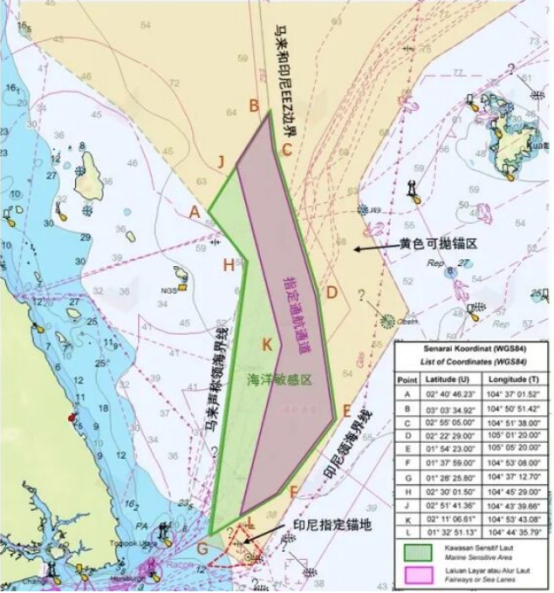
The Notice establishes a Marine Sensitive Area (MSA) near the eastern approaches to the Traffic Separation Scheme in the Straits of Malacca and Singapore, with Designated Fairways or Sea Lanes running through it. For vessels that have long used the OPL area east of the Singapore Strait for anchorage, bunkering, lightering and hold preparation, lawful anchorage space is shrinking further, raising new compliance and operational risks for voyage planning, anchorage strategy and navigational safety. Notably, despite the Notice entering into force on 11 September, many vessels continue to anchor within the sensitive area.
Cargo transfer means the transfer of petroleum, liquefied gas, bulk liquid chemicals or petroleum products between two vessels. It is prohibited unless prior written approval is obtained from the Government. Exceptions apply to: transfers between warships and auxiliary naval vessels; vessels authorised by the Government under relevant legislation; non-commercial government service vessels; and transfers necessary for the safety of the vessel, saving life at sea or responding to marine pollution.
Applications must be submitted at least 48 hours before the planned transfer, accompanied by a ship-to-ship (STS) operation plan approved by the flag State, an environmental declaration, and details of vessel names / flags / IMO numbers, proposed time and location, cargo type and method, and safety measures. Knowingly providing false information, obtaining approval by misrepresentation, failing to carry the STS plan on board, or carrying out the transfer otherwise than in accordance with the plan all constitute offences.Bunkering means the transfer of fuel for a vessel’s engines. Bunkering at sea is prohibited as a matter of principle. Exceptions include: bunkering between a vessel and its lifeboats; warships; vessels authorised by the Government; non-commercial government service vessels; and bunkering necessary for search and rescue operations or responding to specific pollution incidents.
Anchoring is prohibited within the MSA. Exceptions apply only to search and rescue, anchoring due to vessel damage, and combating specific pollution incidents.
Within the MSA, vessels are prohibited from any activity that may harm the ecosystem (such as discharges or propeller wash), and from killing, removing, destroying or disturbing any species of marine flora or fauna.
Activities that may damage the seabed or protected marine organisms are prohibited or restricted. The following require Government approval: dredging, salvage, structural installation, installation / repair / replacement of submarine cables and pipelines, scientific research and geological activities, and exploitation of seabed resources.
Any fishing activity within the MSA requires approval from the Malaysian Fisheries Department under the Fisheries Act 1985 (Act 317).
The Designated Fairways (shown in purple) lie within the MSA (shown in green) but do not exempt vessels from any MSA restrictions. Their purpose is to channel compliant transit through the MSA in an orderly manner, prevent unregulated entry into the sensitive area, and enhance navigational safety in these waters.
Restriction | EEZ | MSA | Designated Fairways / Sea Lanes |
Cargo transfer | Prohibited unless prior approval obtained | Prohibited unless prior approval obtained | Prohibited unless prior approval obtained |
Bunkering | Prohibited | Prohibited | Prohibited |
Anchoring | No specific provision | Prohibited | Prohibited |
Ecological harm | — | Prohibited | Prohibited |
Seabed activities | — | Prohibited / restricted (approval required) | Prohibited / restricted (approval required) |
Fisheries | — | Fisheries Dept approval required | Fisheries Dept approval required |
Vessel size | — | Entry generally prohibited or restricted | LOA ≤ 300 m, beam ≤ 40 m |
Speed | — | — | 12 knots |
As the chart shows, the MSA further reduces the waters available for anchorage (shown in yellow). Areas in the EEZ beyond the territorial sea where Malaysia previously allowed bunkering and cargo STS operations are now also subject to prohibition or restriction.
With anchorage and navigable waters shrinking, crew unfamiliar with the MSA boundaries, restrictions and exemption conditions can easily stray into the sensitive area or breach the rules — leading to detention and penalties.
Owing to the fairway limits, very large vessels must route around the MSA to the south, and some westbound vessels must turn south of the area before joining the westbound lane. This concentrates converging and crossing traffic near the eastern approaches to the Singapore Strait, raising collision risk and significantly increasing bridge team workload and lookout pressure.
Under regulation 5(3) of the EEZ Regulations 2026 and clause 4 of MSA Notice 01/2026, failure to comply with any restriction in the Notice constitutes an offence, and the vessel may be detained by the Malaysia Maritime Enforcement Agency (MMEA). Pending completion of legal proceedings, the owner or master may provide a bond or other form of financial security, together with one or more sureties resident in Malaysia, as a condition for the vessel’s release. The maximum amount of security is MYR 1,000,000.
In addition, failure to comply with the following also constitutes offences:
Where the MMEA has reasonable grounds to believe that serious marine environmental damage is occurring or is likely to occur within the zone, it may, in writing or by radio, direct the owner, master or agent to take measures to prevent or mitigate the damage in accordance with safe navigational practices.
If a vessel in the zone suffers fire, explosion, collision, grounding or any other emergency that may threaten the marine environment, the owner, master or agent must report it to the Government through any official communication channel within 6 hours.
The MMEA may require vessels navigating in Malaysia’s EEZ and on its continental shelf to provide information such as identity, port of registry, and previous and next ports of call. If the master refuses to provide the information or provides manifestly false information, it constitutes an offence. The MMEA may board the vessel for inspection and detain it.
Any person who breaks or damages a submarine cable or pipeline in the MSA, EEZ or continental shelf, or who causes or allows a vessel to do so, commits an offence.
1. Provide masters and deck officers with specific training on Malaysia’s EEZ Regulations 2026 and the MSA Notice, paying particular attention to MSA boundaries, restrictions and exemption conditions.
2. Carefully review voyage plans for vessels transiting the area, ensure the zones established under MSA Notice 01/2026 are incorporated, and carry out thorough passage planning and operational risk assessments.
3. Instruct crew to plot the MSA manually on ECDIS, set off-track and prohibited-area alarms correctly, and apply a 2–3 nautical mile safety buffer beyond the alarm boundary.
4. When transiting the MSA, keep to the purple Designated Fairways, avoid entering other parts of the green MSA wherever possible, and maintain speed at no more than 12 knots. Vessels exceeding the length or beam limits must not cross the MSA; route east or south of the area instead.
5. If anchoring in the yellow unrestricted area, verify and assess the position carefully and stay clear of submarine cables and pipelines. Monitor the latest developments in Malaysia’s EEZ restrictions and be aware of the mandatory application requirements for Indonesia's designated anchorages south of the yellow area.
6. When planning operations in these waters, contact local agents for detailed requirements and arrange necessary permits in advance. Where appropriate, liaise directly with the relevant Malaysian authorities.
For more information, please contact Managers of the Association.