
LP 02/2026 New Standards for Biofouling Management in Brazil
Latest Update on January 20
The Brazilian Navy, through the Directorate of Ports and Coasts, has postponed the application of penalties provided under the new biofouling control and management regulation to 10 June 2026, with the aim of granting additional time for the maritime community to adapt.
Circular Issued on January 19
In June 2025, the Brazilian maritime authority, through the Navy’s Directorate of Ports and Coasts (DPC) issued Ordinance DPC/DGN/MB No. 180/25, approving the first revision of the NORMAM-401, which establishes a regulatory framework for biofouling management in Brazil, aligned with the revised IMO Guidelines (Resolution MEPC.378(80)).
Taking into account the particular characteristics of the Brazilian coastline, it aims to standardize biofouling control and management practices in order to minimize the risk of bio invasion in Brazilian Jurisdictional Waters (“AJB”). Since the enforcement period for penalties is expected to commence on 1 February 2026, the Club’s local correspondents BRAZMAR has provided an updated circular summarizing the key provisions, followed by a Frequently Asked Questions (FAQ) section to help Members get prepared.
I. General Requirements
All vessels exceeding 24 metres in length, whether they are underway, anchored, or laid up within Brazilian jurisdictional waters, are required to comply with the IMO Biofouling Guidelines and must carry on board, a Biofouling Management Plan (BFMP), and a Biofouling Record Book (BFRB). Both the BFMP and the BFRB must be readily available for verification by the relevant local authorities. Offshore platforms and their support vessels subject to environmental licensing must also comply with the requirements established by the competent environmental authority.
In accordance with the IMO Guidelines, vessels must implement the routines set out in BFMP and record all relevant activities in BFRB, including, among others, inspections, dry-dockings and in-water cleanings. The minimum required content of BFMP and BFRB is set out in Annex H of NORMAM-401. Notably, BFMP should address at least the following points:
- The proactive maintenance and cleaning regime based on vessel-specific risk assessment.
- The schedule for inspections between and during planned docking in the vessel-specific risk assessment.
- The procedures for cleaning actions if macrofouling is observed during inspections.
- Contingency procedures to manage biological fouling that may accumulate if the ship deviates from its operational profile.
- The regime of repairs, maintenance and renewal of the Coating System (AFC), when close to the end of its useful life, according to the manufacturer's instructions.
- The monitoring of Marine Growth Prevention Systems (MGPS) to assess their effectiveness in inhibiting biofouling, including maintenance provided in accordance with the manufacturer's instructions.
- Safety procedures for the ship and crew, training and familiarization of the crew regarding the management of biofouling.
- Capture, collection and final disposal of biofouling management waste.
The BFRB shall contain all records relating to the vessel’s biofouling management activities and shall be separated into two parts. In the first part, the records of activities planned by BFMP must be included. The detailing of the information, including observations of the biofouling before and after proactive cleaning are important for the continuous improvement of risk assessment. The second part should include the operational events that exposed ships to a higher risk of biofouling accumulation. Records of deviation from the operational planning defined in the BFMP and record of contingency actions taken in response to operational deviation must be entered.
II. Biogeographical Regions
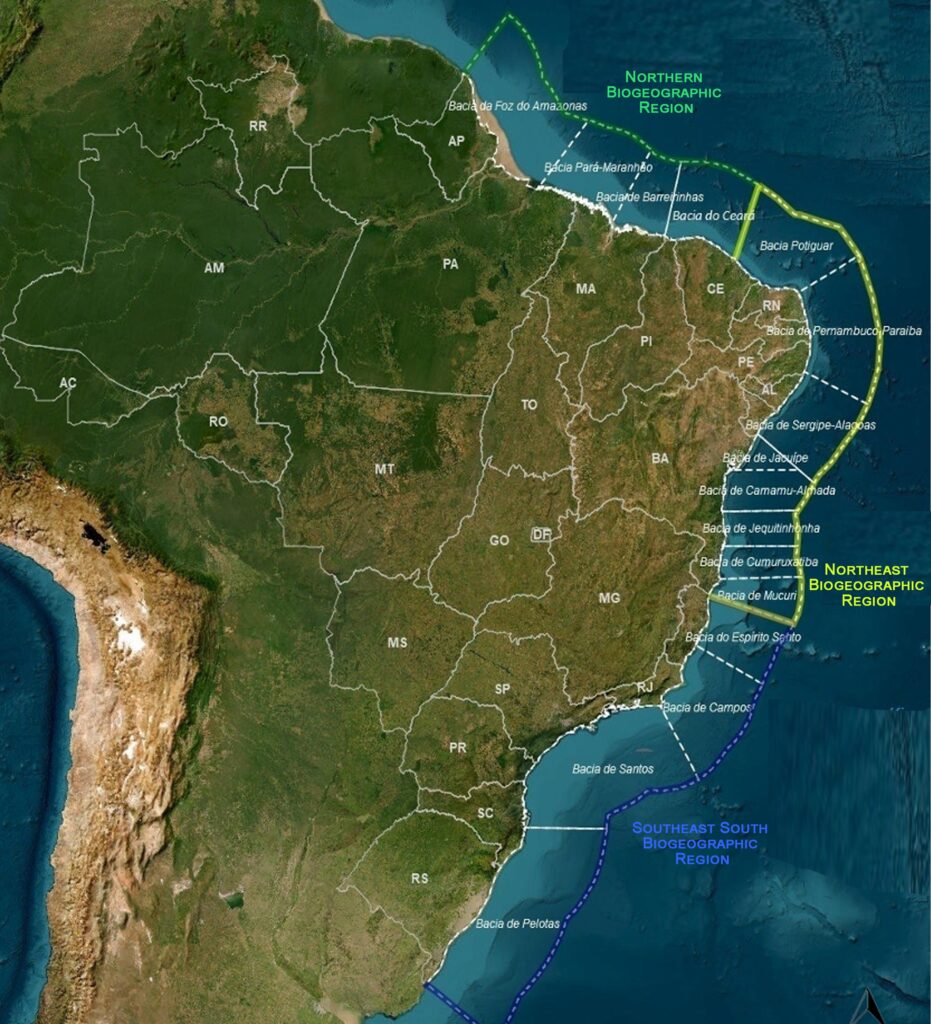
Considering the size of the Brazilian coastline and its biotic and abiotic characteristics, Annex I of NORMAM-401 divides the coast into three marine biogeographical regions:
North (green) – comprising the area between the Maritime Basin of the Mouth of the Amazon River and the Maritime Basin of Barreirinhas, limited to the east by the Maritime Basin of Ceará (Alto de Tutóia).
Northeast (yellow) – extends between the Maritime Basin of Ceará and the Maritime Basin of Mucuri.
South/Southeast (blue) – stretching between the Maritime Basin of Espirito Santo and the Maritime Basin of Pelotas.
III. Biofouling Rating Scales
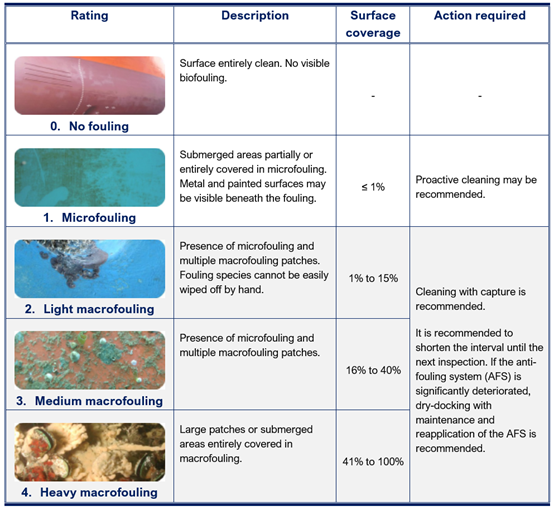
Vessels intending to enter the AJB are required to present a biofouling level equal to or lower than Level 1, corresponding to microfouling. Where a Vessel presents biofouling at Level 2 or above, the recommended measures include cleaning with capture of residues, together with a reduction in the interval until the next inspection. Where deterioration of the antifouling system is identified, dry-docking for maintenance and/or reapplication of the antifouling coating is recommended. The biofouling rating scale and recommended cleaning practices are set out in Annex J of NORMAM-401.
Any vessel intending to carry out in-water cleaning must request authorization from the local Agent of the Maritime Authority (“AM”), preferably with a minimum advance notice of ten days, or otherwise as far in advance as practicable. All procedures and supporting evidence, including inspection, monitoring and cleaning reports, must be duly recorded and kept on board. The request for in-water cleaning should include also the following documents:
- International Certificate/AFS declaration and methodology suggested by the manufacturer for removing biofouling, when applicable;
- Biofouling Management Plan and Biofouling Record Book;
- Chronological history of ports called since the last cleaning, when available;
- Latest inspection report of the hull/niche areas with clear and high-resolution images, if applicable;
- Biofouling removal plan detailing the team involved, methodology, equipment, waste capture rate, and the location where the proposed operation will take place; and
- Any additional information deemed relevant.
IV. Penalties and Sanctions
Non-compliance with the established obligations may result in administrative penalties, including warnings, fines and, in certain cases, restrictions on operations within the AJB. Enforcement and the application of sanctions fall within the competence of the AM.
Penalties are applied following a formal administrative procedure in accordance with Law No. 9,605/1998 and NORMAM-401. Typically, an infraction notice is issued, after which the interested party may submit a written defense, present supporting documentation and request admissible evidence within the applicable deadlines. Following a decision, the party is notified to either pay the fine or lodge an administrative appeal. Sanctions are only applied after the conclusion of the administrative procedure.
Under Law No. 9,605/1998 and Decree No. 6,514/2008, fines may range from BRL 500 to BRL 50,000,000; and BRL 500 to BRL 2,000,000 respectively. If the incident is classified as a serious pollution event, then, without entering into technicalities for present purposes, additional civil and criminal sanctions may also apply. Penalties may be increased up to three times for repeat offences or doubled if another environmental violation occurs within five years of the first infraction.
V. Frequently Asked Questions (FAQs)
The following FAQs summarize discussions held with the DPC on key practical aspects of the regulation.
a) When did NORMAM-401 and the biofouling obligations enter into force?
The regulation entered into force in June 2025, initially without the application of penalties. Penalties are currently expected to apply from 1 February 2026, although the DPC has indicated that this deadline may be extended. We will continue to monitor developments and provide updates as appropriate.
b) Have advisory inspections already commenced?
According to the DPC, guidance has been provided to the maritime community through lectures, meetings and forums, as well as by AMs within their respective jurisdictions.
c) With regard to current or any future inspections, please clarify how such inspections will be conducted. By way of example, will inspections be carried out at anchorage and/or at berth, and is there any possibility that underwater inspections may be required?
Inspections will begin with a review of documentation submitted during vessel clearance procedures and will be conducted in accordance with the standards applied by Naval Inspection teams, subject to regional practices and the discretion of the relevant AM.
d) Is in-water cleaning of Level 1 biofouling permitted without residue capture?
Yes. In-water cleaning of Level 1 biofouling may be carried out without the need to capture residues.
e) Is there a list of authorized locations or approved service providers for cleaning at Level 2 or above?
There is no formal accreditation of companies or laboratories by the Maritime Authority. However, the use of reliable and duly certified service providers is recommended. The Club’s correspondents remain available to assist Members in identifying suitable companies. Cleaning may be carried out at shipyards or, when conducted in water, within port areas, subject to authorization by the Port Authority or terminal operator.
f) Have any authorizations for in-water cleaning already been issued, and what is the typical timeframe?
Authorizations are issued by the relevant AMs, and there is no centralized data regarding processing times.
g) Taking into account the provisions of item 4.1.4 of NORMAM-401, have any exemptions to the regulations already been granted, or whether there is a possibility for an exemption to be granted, in situations where a vessel’s hull presents biofouling above Level 1 but there are no technically feasible means available at the relevant location to carry out cleaning in accordance with the requirements of the standard?
Such situations should be submitted to the Maritime Authority for consideration, as provided for in item 4.1.4 of NORMAM-401.
h) Are there any additional considerations?
Port State Control inspections will follow the standards of the Viña del Mar Agreement and may be more frequent for vessels deemed non-compliant with the regulations. In cases of non-compliance, PSC may notify the authority responsible for initiating environmental administrative proceedings, which may result in fines under Law No. 9,605/1998.
The above is based on circulars provided by BRAZMAR and PROINDE. For more information, please contact Managers of the Association.
| File | File size |
|---|---|
 LP022026 New Standards for Biofouling Management in Brazil.pdf LP022026 New Standards for Biofouling Management in Brazil.pdf | 981 kB |