
LP 08/2026 Iran Conflict: JWC Listed Areas Updated
I. Current Threat Level
Geopolitical tensions continue to escalate in the Persian Gulf and the Straits of Hormuz. With the Iranian Islamic Revolutionary Guard Corps (IRGC) broadcasting warnings on VHF Channel 16 and threatening strikes on all vessels transiting the Straits of Hormuz on March 2nd local time, there have been several reports of attacks against merchant vessels in the region, including the Skylight incident. Meanwhile, it is reported that the Houthi forces have resumed attacks on passing vessels in the Red Sea, heightening security risks throughout the Red Sea, Indian Ocean, and Gulf of Aden.
The current situation in the Persian Gulf region presents the following characteristics:
- Reduction in traffic: Although the strait has not been formally and legally closed, commercial navigation has been substantially affected, with many vessels stranded.
- Port operations disrupted: Port Jebel Ali in the UAE, Port Duqm in Oman, and all ports in Bahrain have once suspended operations.
- Navigational risks: GNSS jamming, combined with risks of drone attacks, missile strikes, and armed interception, has raised maritime security to the highest level in nearly a decade.
Due to the ongoing regional instability, the Persian Gulf, Strait of Hormuz, and Gulf of Oman, together with the Red Sea, Indian Ocean, Gulf of Aden, now present the highest risk for global shipping.
II. War Risks Cover
The Joint War Committee released JWLA-033 on March 3rd to add Bahrain, Djibouti, Kuwait, Oman and Qatar to the listed areas for hull war, piracy, terrorism and related perils. The committee also amended the listed area described as the Persian/Arabian Gulf, Gulf of Oman, Indian Ocean, Gulf of Aden and Southern Red Sea, setting out revised geographical boundaries.
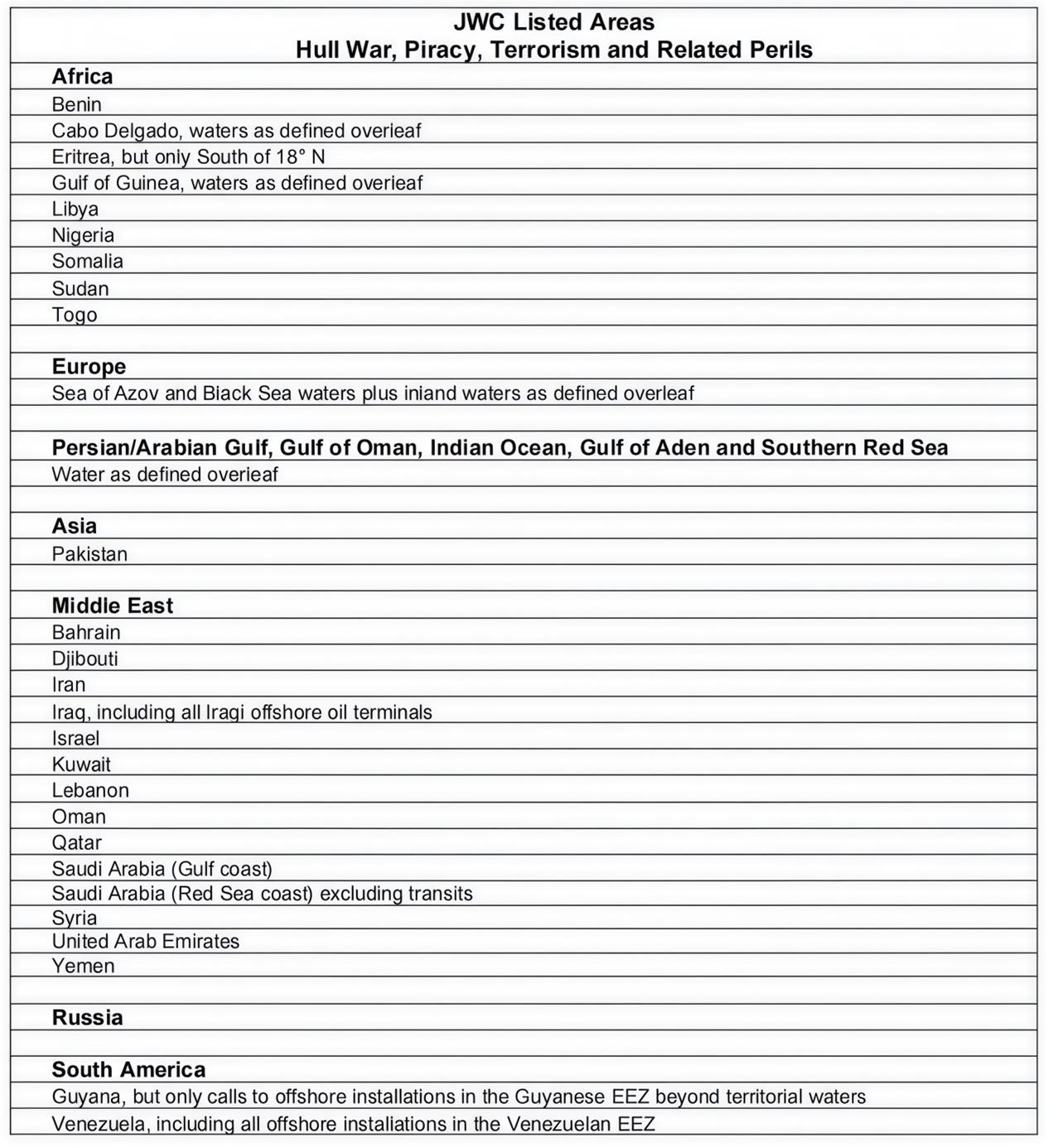
With the application of the list on individual contracts subject to specific negotiation, some insurers have issued notice of cancellation in respect of War Risks, and more are expected to re-evaluate additional premium rates and conditions. Members are recommended to always consult the insures first if planning to enter or already entered these areas.
Key Points for Additional Arrangements:
- Application: To make new arrangements for additional cover, submit applications to the Association at least 48 hours before entering the JWLA-033 listed areas and confirm acceptance of insurer conditions in writing. For heightened risks in the area, inform the Association 24 hours in advance.
- Validity: Additional premium rates and conditions are typically valid for only 48 hours (sometimes 24 hours). If vessels are not in the listed area within this period, quotes are automatically expired and require reconfirmation.
- Cancellation: Under JW2022/007A, the insurer and the insured are entitled to give notice of cancellation, the period of which is typically 7 days, but 72 hours for circumstances involving one of the five powers. In case the situation changes drastically, either party has the right to terminate the insurance (including special arrangements that have taken effect).
III. Advice to Members
Apart from insurance arrangements, the Association recommends implementing risk assessment in contract terms and operational decisions:
A. Sanction Compliance
Given the complexity in the region, war risk policies typically include Sanctions Exclusion Clauses. Members are nevertheless recommended to exercise due diligence in verifying counterparties, cargos, and funds to ensure compliance with applicable sanction schemes of the UN and other nations.
B. Charterparty Considerations
When reviewing charterparty terms, Members are recommended to check for consistency with insurance conditions, such as incorporation of B&T clauses, identifying who is responsible for additional premiums, and verify the credibility of insurers provided by charterers. For GPS interference, include clear terms regarding delay responsibilities due to navigation equipment failures.
C. Voyage Planning
Considering current dynamics, the Association recommends:
- Negotiating route adjustment plans with cargo owners and charterers in advance;
- Clarify responsibilities and consequences for changes in routes (e.g., via Cape of Good Hope) and port of calls, and potential delays;
- Monitor security updates from UKMTO, JMIC and adjust voyage plans accordingly.
D. Loss Prevention Measures
- Consider re-routing: try not to enter the area if it’s not necessary; vessels already in the region should seek safe anchorage and determine the earliest possible time for departure with local agents.
- Elevate security level: raise maritime security to ISPS Level 2, implement 24-hour watch, maintain visual and radar lookout, and continuously monitor VHF CH.16.
- Navigational safety: stay away from military vessels, ensure AIS is switched on, and develop contingency plans for GNSS jamming using radar and celestial navigation.
- Drills & equipment checks: Conduct security drills for missile/drone attack scenarios; thoroughly inspect any firefighting, lifesaving, communication, and medical equipment.
- Crew welfare: Ensure crew accommodations are above the waterline; provide mental support and make early plan for crew change/repatriation.
IV. CPI Emergency Response
The Association has been closely monitoring developments in the Persian Gulf and surrounding areas in response to Members’ enquiries on risk intelligence and insurance cover. Our Hull Department has set up a team on crisis response and coordination, specifically to offer:
- 24/7 response to additional cover negotiations and arrangements;
- Update on local developments and port operation stats;
- Coordination with local correspondents.
To meet market needs, the Association also provides one-off voyage cover for war risks, particularly for vessels entering listed areas.
Members are urged to be cautious of current risks in the Persian Gulf, maintain communication with war risk insurers, stay informed and take necessary precautions.
Disclaimer: This circular is for risk alert and operational guidance only. It does not constitute part of insurance contracts, nor does it modify, supplement, or extend responsibilities and exclusions under Association policies. Specific insurance coverage is subject to formal insurance contracts and corresponding terms.
Previous articles on war risks:
- https://www.chinapandi.com/index.php/en/loss-prevention-menu-en/loss-prevention-content-en/5683-article-5683
- https://www.chinapandi.com/index.php/en/loss-prevention-menu-en/loss-prevention-content-en/5451-article-5451
| File | File size |
|---|---|
 LP 082026 Iran Conflict JWC Listed Areas Updated.pdf LP 082026 Iran Conflict JWC Listed Areas Updated.pdf | 618 kB |